I recently met up with the lovely folks at Saul Good Gift Co. – a Vancouver gift basket company providing unique customized gourmet and organic corporate gift solutions – to talk about some of the basic rules of food & wine pairing. We also got to sit down and try some of the local and organic goodies that Saul Good features in his amazing gift baskets.
Check out the following link and read about our findings!
The grape varietal that wants to be popular, but just can’t seem to make it. The grape varietal that adds structure and a backbone in blends, but just can’t seem to “make it” among world wine drinkers. What’s with that anyway? That being said, I know a number of vineyards which grow Cabernet Franc and which make a single varietal wine out of it. The issue with Cabernet Franc tends to lean towards it being a favourable grape to add to blends in order to increase colour and fragrance, thus detracting its value as a single-varietal wine.
For those who don’t know a lot about Cabernet Franc, it enjoys warm, drained soils, similar to its “son” grape, Cabernet Sauvignon, also known as “the king of grapes”. Cab Franc tends to produce wines with less body and finesse than its son, although there are a few exceptions. The grapes tend to show stalky and herbaceous flavours similar to its relative, but can have a berry basis and be quite fragrant when all elements come together beautifully. Well suited to the Loire Valley, as the cool continental climate allows Cabernet Franc to flower and ripen early, wines from the Loire tend to be perfumed and juicy with light tannins and high acid. Tip: drink French Cabernet Franc’s slightly on the chilly side.
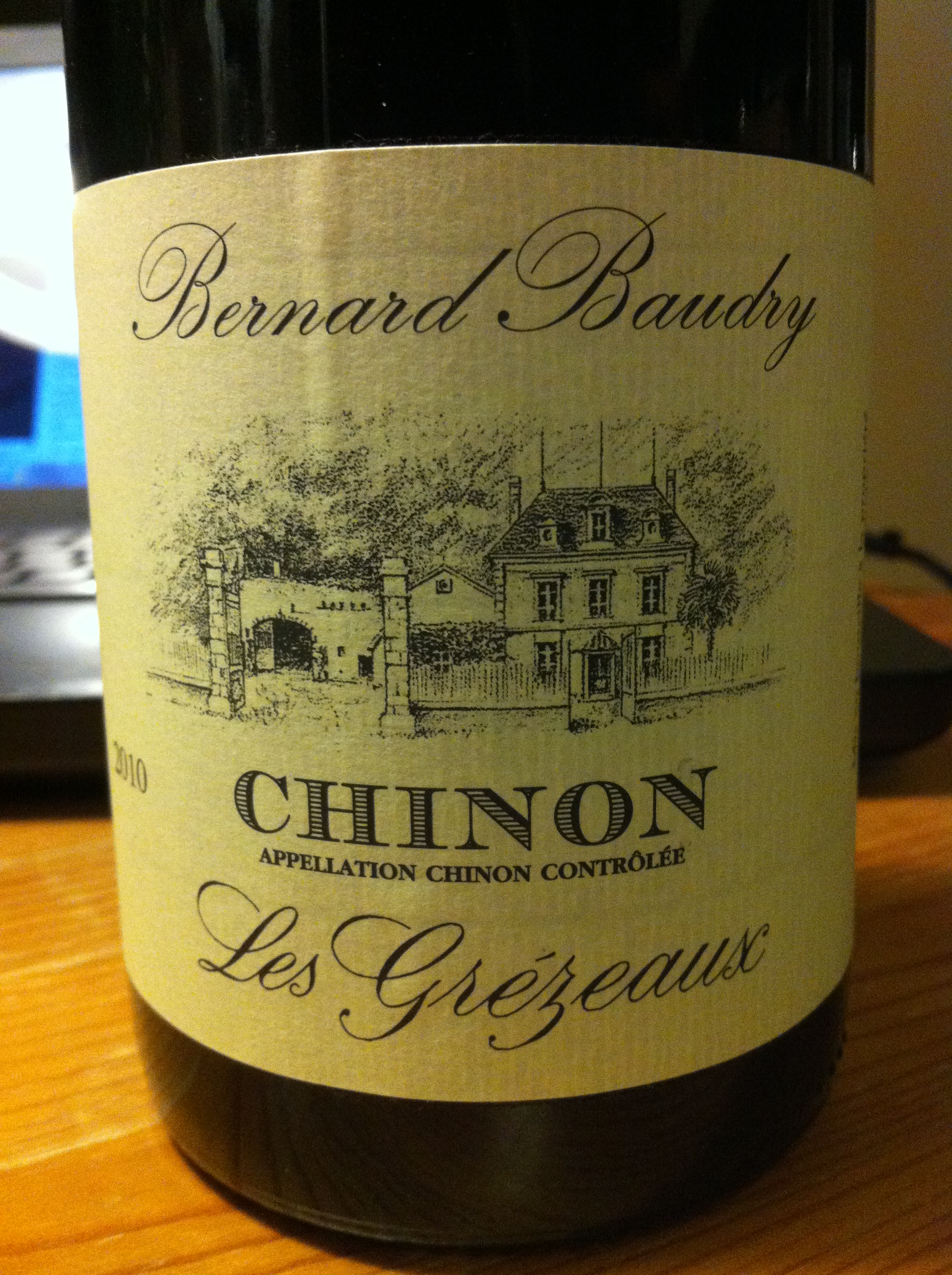
Bernard Baudry “Les Grezeaux” Chinon 2010
Bernard Baudry‘s Cabernet Franc is from the Chinon AC. The Chinon AC makes mostly reds from Cabernet Franc. The terroir of the Chinon appellation is quite varied, and ranges from sandy soils to gravel to limestone, which then varies how this varietal will reveal itself in wine.
Having had the opportunity to try “Les Grezeaux” Chinon by Bernard Baudry, the wine fit a few of the main descriptors listed above. It held a clean, medium intensity bouquet with dark fruit and toasted oak. The 13% abv wine was dry, with fine medium-grained tannins, and a slightly stronger-than-light but not-quite-medium body. The palate was more interesting than the bouquet. Black fruit-forward with a currant punch, and a nutmeg and cinnamon-infused medium length finish, I enjoyed “Les Grezeaux” for what these 50+ year old vines could show me about Cabernet Franc.
I spoke to Sandra Oldfield, the CEO, President, and Winemaker at Tinhorn Creek in the Okanagan. She is an advocate of showing just how beautiful Cabernet Franc can be as a single-varietal wine, and she confidently sticks-up for it as well. Tinhorn Creek’s Cabernet Franc sells out yearly, and it shows that preconceived notions can be undone. Being a signature grape grown in the vineyard at Tinhorn Creek, it also reveals just how well Cabernet Franc can show even in a somewhat different climate (and very different terroir) than the Loire Valley in France. Rick van Sickle noted that Tinhorn Creek’s Cabernet Franc is:
…[a] classic Cab Franc with raspberry-bramble bush aromas followed by currants, soft spice, tobacco and licorice. It’s simply delicious on the palate with raspberries and dark fruits, earth, cedar, smoke, herbs and gritty tannins that all lead to a long finish. (Quoted here.)
Interesting, considering terroir and climatic differences can truly engage a varietal’s character in different and not-so-good ways. In other words, Cabernet Franc is showing the wine world that it can stand up to the various differences of geographical influence and still hold its own. I asked Sandra Oldfield what makes this grape so special for her. Her response:
Cabernet Franc is perfectly suited to what vintners are trying to do in the South Okanagan. The vines thrive in our climate and pretty well make themselves in the cellar. I have made 17 vintages of Cabernet Franc from our estate vineyard now, and am convinced it was one of the best decisions we made many years ago when our winery began.
What I enjoyed most about her response, was that Cabernet Franc “makes itself” in the cellar. Who knows, maybe Cabernet Franc is trying to be as bold as its son, and may well show Cabernet Sauvignon who’s boss one day.
“Les Grezeaux” Chinon is available at select private BC wine stores, and if you’re thinking about trying Cabernet Franc as a single-varietal bevvy now, why not go for the more carbon-neutral option (as well as a local one) and try Tinhorn Creek’s Cabernet Franc. It only won Gold in 2012 at the BC Wine Awards. No big deal.
Pentâge Winery, located in Penticton, B.C., is a smaller winery overlooking Skaha Lake in the Okanagan. Paul Gardner & Julie Rennie started Pentâge back in 1996. This winery’s focus is on reflecting the terroir of the vineyard, and ensuring that their low-yield cropping strategy produces the best quality, hand-crafted wines.
Pentâge Winery got its name for a special reason. Penta, meaning “5” in Greek, is the root of their winery name, but also their well-known red blend, called “Pentâge”, of five estate-grown varietals. Merlot, Gamay, Syrah, Cabernet Sauvignon, and Cabernet Franc are all harvested, aged, and then blended each year in differing volumes to reflect the most palatable blend according to that vintage’s harvest. I sort of like it when a winemaker takes enough pride in his/her product to recreate and revitalize a tradition. Bravo!
Photo Copyright Valerie Stride 2012
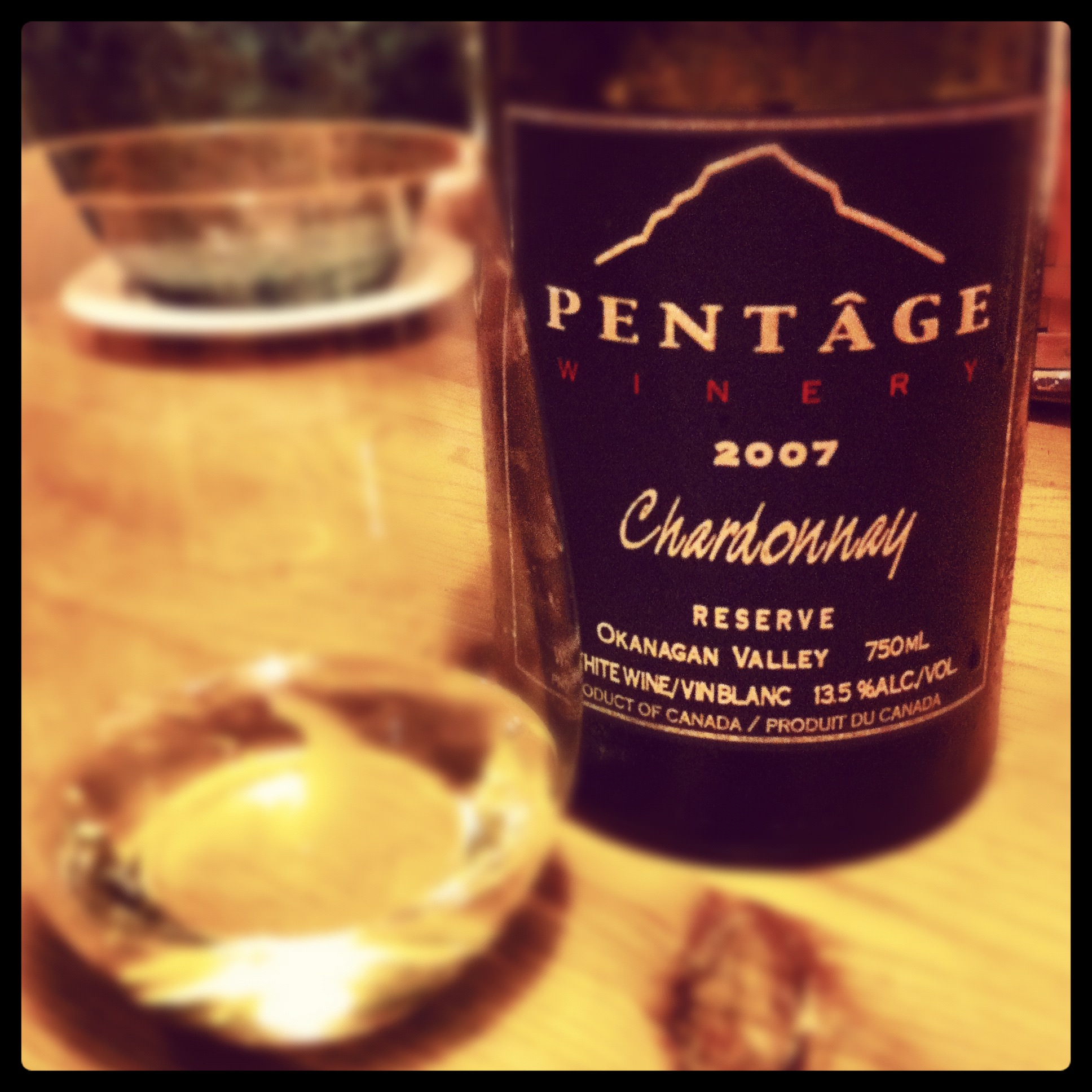
After seeing an attractive sounding blurb about this Chardonnay of theirs in the Swirl email I get on a weekly basis, I couldn’t wait to get my hands on a bottle. I kept it for about 10 months or so, and finally decided that I was going to open this Reserve Chardonnay that I had so badly wanted to purchase.
For a 5 year old BC white wine, it was holding nicely. Sitting at 13.5% abv, the alcohol was not hot or flat. This Chardonnay had already begun taking on golden hues; as the rules go, white wines tend to deepen their colour intensity with age, whereas reds tend to fade.
The initial whiffs on the bouquet revealed oak. It was not overpowering or intrusive, but a nice toasted wood scent alongside hints of vanilla, citrus, tropical fruits, peach skins, melon, and a hint — just a hint — of butter. The bouquet on this wine was intoxicating. It was definitely one of those times where it took me so long to actually have a sip, because I was enraptured by what my nose was capturing!
On the palate, the high acid, medium intensity, and medium bodied wine showed good balance and confidence. Sweet vanilla toast, lemon juice, peach and butter all came forward to play.
For optimal quality, drink it right away. While this charismatic Chardonnay is drinking beautifully, I would not want to age it much more. This is a Reserve you do not want to miss. Waiting might be a deal with the devil. Drink now, and ensure you finish the bottle, as it didn’t last overnight even with the oxygen sucked out of the bottle. That is not an issue though, right?
Available in special wine & liquor stores for under $30.
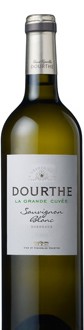
I’m going to lure you into the wine store with a good reason. Try the 2010 Bordeaux Blanc ‘La Grande Cuvee’ from Vins & Vignobles Dourthe.
Go.
Okay, for those of you who are still sitting in front of your screens reading this, I shall continue. I shall ask you a few questions first:
Do you enjoy Sauvignon Blanc?
What style(s) of Sauvignon Blanc do you like?
Are you a fan of New Zealand style Sauvignon Blancs over French styles?
Would you be open to trying what I was hoping you’d already be out the door heading to purchase?
Only you can answer any of those questions, but ponder this: it is not often that you’ll see a single varietal wine coming out of Bordeaux for historical reasons. (More on that later.) This wine, my friends, is special. And good. Now, normally I wouldn’t begin a sentence with a conjunction; it’s just not cool. However, this Bordeaux Blanc is cool, and at about $13.99/bottle, you cannot go wrong.
Clear pale lemon green, crisp, and refreshing, this Vins & Vignobles Dourthe wine calls the shots on what a classic Sauvignon Blanc is. Both interestingly and surprisingly, I began the debate during my blind tasting about whether or not this wine followed New World or Old world style because of its characteristics. The bouquet and palate combination on this wine almost tricked half of my class into thinking it was a New Zealand Sauvignon Blanc! There were a few of us who suspected that Tim Ellison, our Sommelier instructor, might throw a curve ball at us during our blind tasting on Bordeaux, and well, we got a curve ball – just a French one!
As mentioned earlier, Bordeaux does not tend to produce single-varietal wines. Historically speaking, Bordeaux’s moderate maritime climate provides this lovely region with 950mm of rain per year. As a result of the heavy rainfall, and because different varieties of grape blossom, fruit, flower, etc. at different times, Bordeaux winemakers found that they never really harvested a full crop for any one varietal. So, in order to make enough wine, they had to blend.
For a Bordeaux Sauvignon Blanc, this La Grande Cuvee showed classic notes of distinct herbaceousness. I actually got hints of asparagus from the bouquet, which tickled me pink. Grass, citrus tones, and a particularly clean stoney minerality were all par for the bouquet course. The website clearly states that:
The Sauvignon Blanc undergoes a highly specialised vinification process to unleash the varietal’s aromatic concentration, while retaining great freshness.
On the palate, this youthful wine reveals high acid, medium alcohol, medium body, and a medium intensity experience of grassiness, dried hay, and white stone. Definitely a “drink now” kind of wine, you’ll be going back to buy another bottle to share with your friends at a dinner party. Fall and winter isn’t just for red wines, you know.
Paired perfectly with mixed greens and lemon poppy seed dressing.
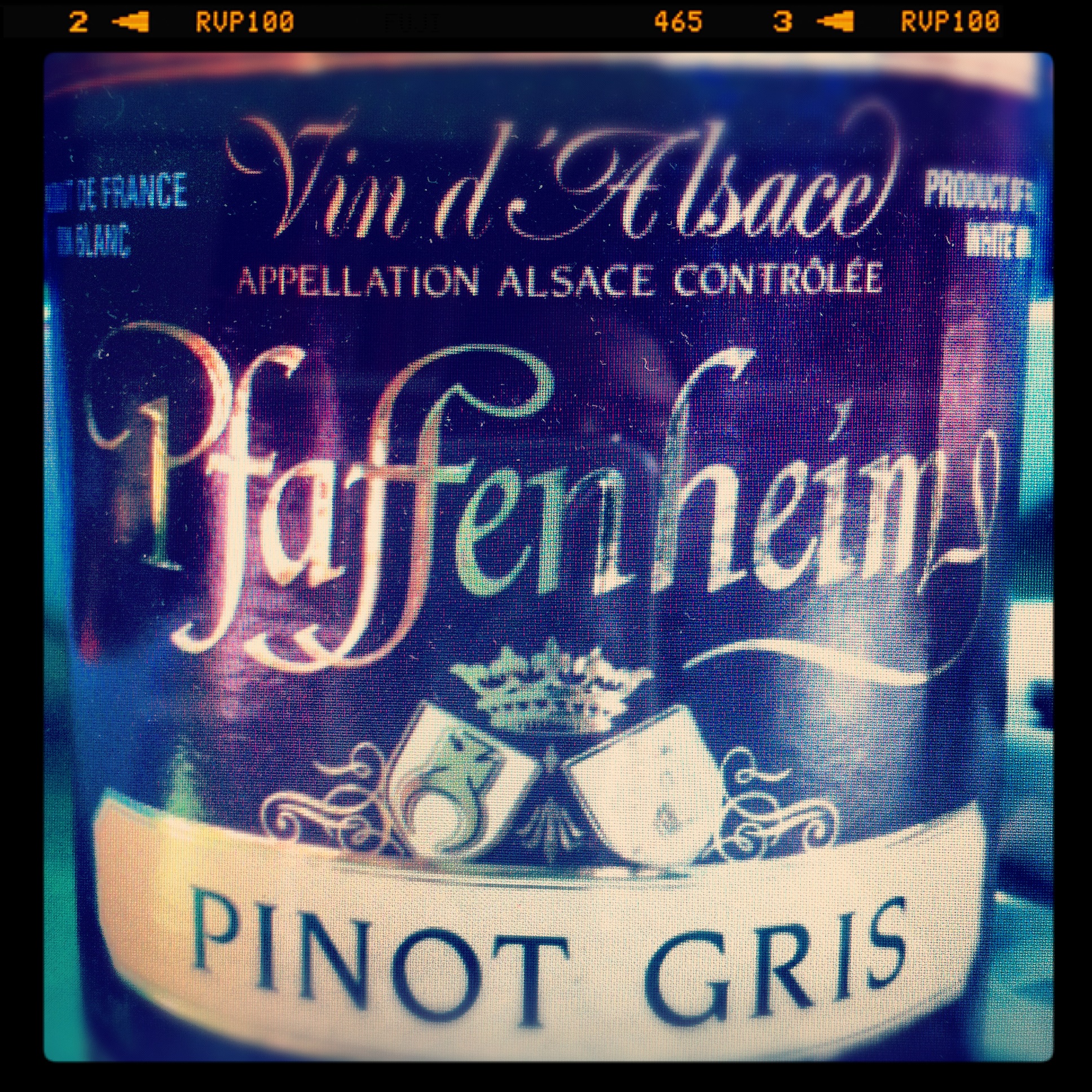
Pfaffenheim is a brand that I stand behind for good quality, complex, and affordable wines. They really know how to make an amiable product. As Pfaffenheim’s wines are made in the Alsatian style, I particularly enjoy their Gewürztraminer, as it bursts forth with tropical fruit flavours. Alsace pushes the “edges” of wine by making bold, crisp, and “extreme” styles. Pfaffenheim does a great job of representing these traits. Now, their Pinot Gris is no exception to the rule; Alsace is known to produce some of the finest Pinot Gris around. Lucky for Pfaffenheim, eh?
Pfaffenheim Pinot Gris label 2011
In the White Wine Guide, Jim Ainsworth & Simon Woods point out the following about Pinot Gris:
The diversity of dry white wines made with Pinot Gris is alarming. […] Top Alsace Pinot Gris can be golden in colour, occasionally with a pink tinge, with a heady, spicy bouquet, a rich, oily texture and plump citrus-fruit. […] In Alsace, even the humble versions have body and spice, while better wines can have hints of smoke, honey and butter, allied to flavours of peaches, crystallized fruit and minerals. It usually seems that there is insufficient acidity for them to age, but they do so remarkably. (pg. 102-103)
At 13.5%, this golden coloured white wine showed excellent characteristics typical of Pinot Gris. Its fruity and sweet bouquet was of light+ intensity, but it wafted of honey and juicy ripe pears, with a fresh squeeze of lemon. This off dry wine had the added curiosity of minerality on the palate and a hint of biscuit. The honey sweetness continued on the palate, and proved delightful, as the viscosity of the wine was slightly creamy, leaving one to imagine the similarity to a liquified honey. Now, don’t get me wrong! This wine was not overly sweet or thick in texture; it simply mirrored honey in a very delicate way. The finish was light, and it had white stone essences to it. All said and done, Pfaffenheim’s Pinot Gris seems to be a good illustration of what an Alsatian Pinot Gris is capable of presenting.
I tried their Pinot Gris alongside some Malaysian cuisine in early September. The Pinot Gris paired excellently with the Ipoh Char Hor Fun & Rendang Beef Curry dishes I ordered. This is most likely due to the fact that the viscosity (think 2% milk for a white wine of this style) paired well with the gravies in the dishes. The medium+ acidity perfectly complemented the prawns in the noodle dish.
Fast Fact: Pinot Gris is known as the “spicy” Pinot, and it is a mutation of Pinot Noir!
Pfaffenheim’s Pinot Gris is available at BC Liquor Stores and LCBO stores for $17.99 and $19.95 respectively.
 The Demystified Vine